Understanding Your Property Tax Calculation
Understand the Texas property tax formula: assessed value minus exemptions times tax rate. See a real example calculation for your home.

Ever looked at your property tax bill and wondered how they came up with that number?
Your property tax bill isn't a mystery—it's math. And once you understand the formula, you'll see exactly where your money goes and where savings might be possible.
Every Texas property tax bill follows the same basic formula. While your bill may look complex with multiple line items and different amounts, it all comes down to one calculation applied multiple times by different taxing entities. This formula is the key to understanding where your money goes—and where you might be overpaying.
The Basic Property Tax Formula
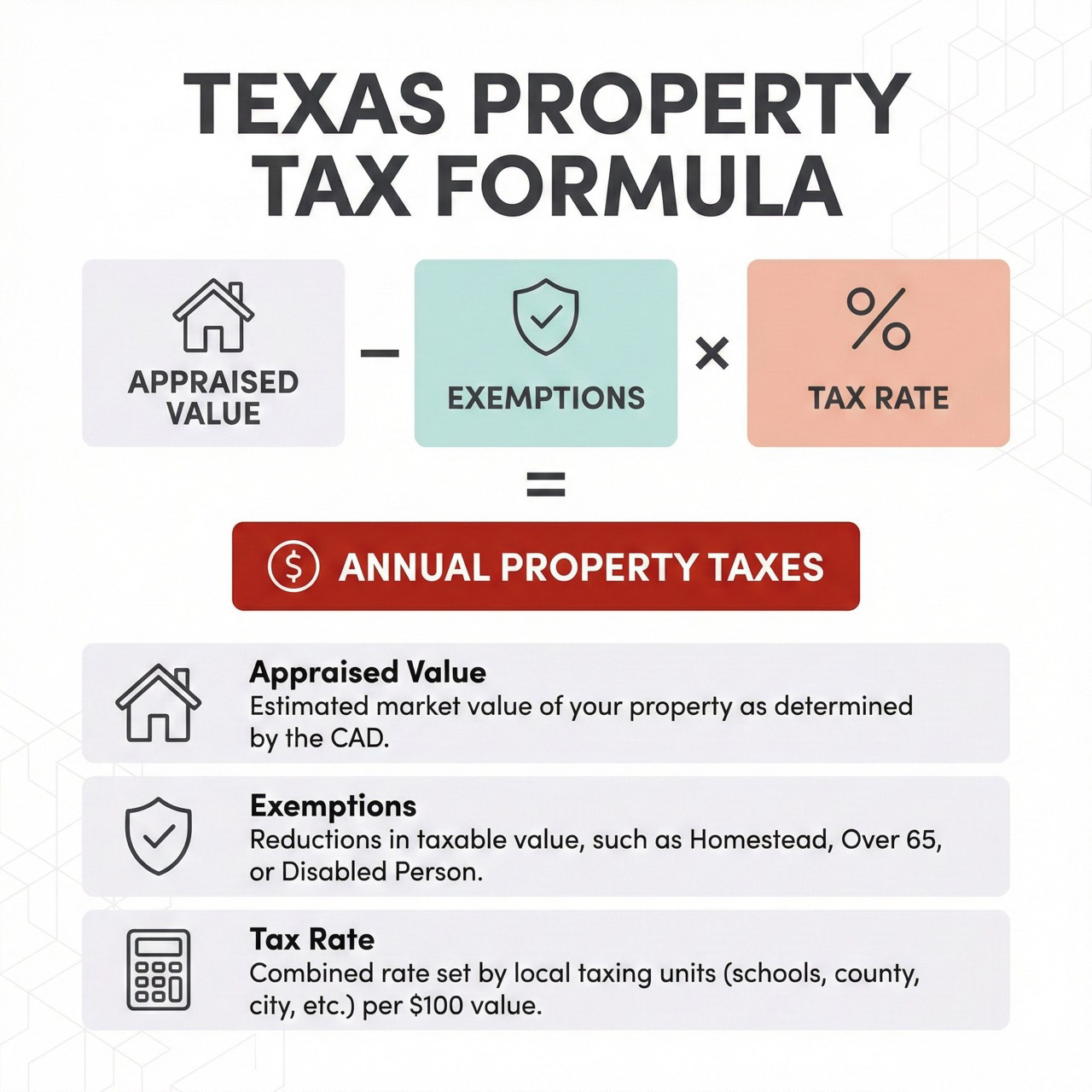
The Texas property tax formula is straightforward:
(Appraised Value – Exemptions) × Tax Rate = Annual Property Taxes
Here's what each part means.
Appraised Value
This is what the County Appraisal District (CAD) determines your property is worth as of January 1. The CAD uses mass appraisal methods—analyzing recent sales, property characteristics, and market conditions—to estimate the market value of every property in the county.
For homesteaded properties, the appraised value may be limited by the 10% homestead cap, which prevents your assessed value from increasing more than 10% per year (excluding new improvements).
Exemptions
Exemptions reduce your taxable value. The most common is the homestead exemption, which removes $140,000 from your taxable value for school district taxes (as of 2026). Other exemptions include over-65 exemptions, disability exemptions, and veteran exemptions.
After exemptions are subtracted, you're left with your "taxable value"—the amount that actually gets taxed.
Tax Rate
Each taxing unit sets its own tax rate, expressed as dollars per $100 of taxable value. For example, a rate of $1.25 means you pay $1.25 for every $100 of taxable value.
For a detailed explanation of the difference between market value, assessed value, and taxable value, see Market Value vs. Assessed Value vs. Taxable Value.
Why You Pay Multiple Taxing Entities
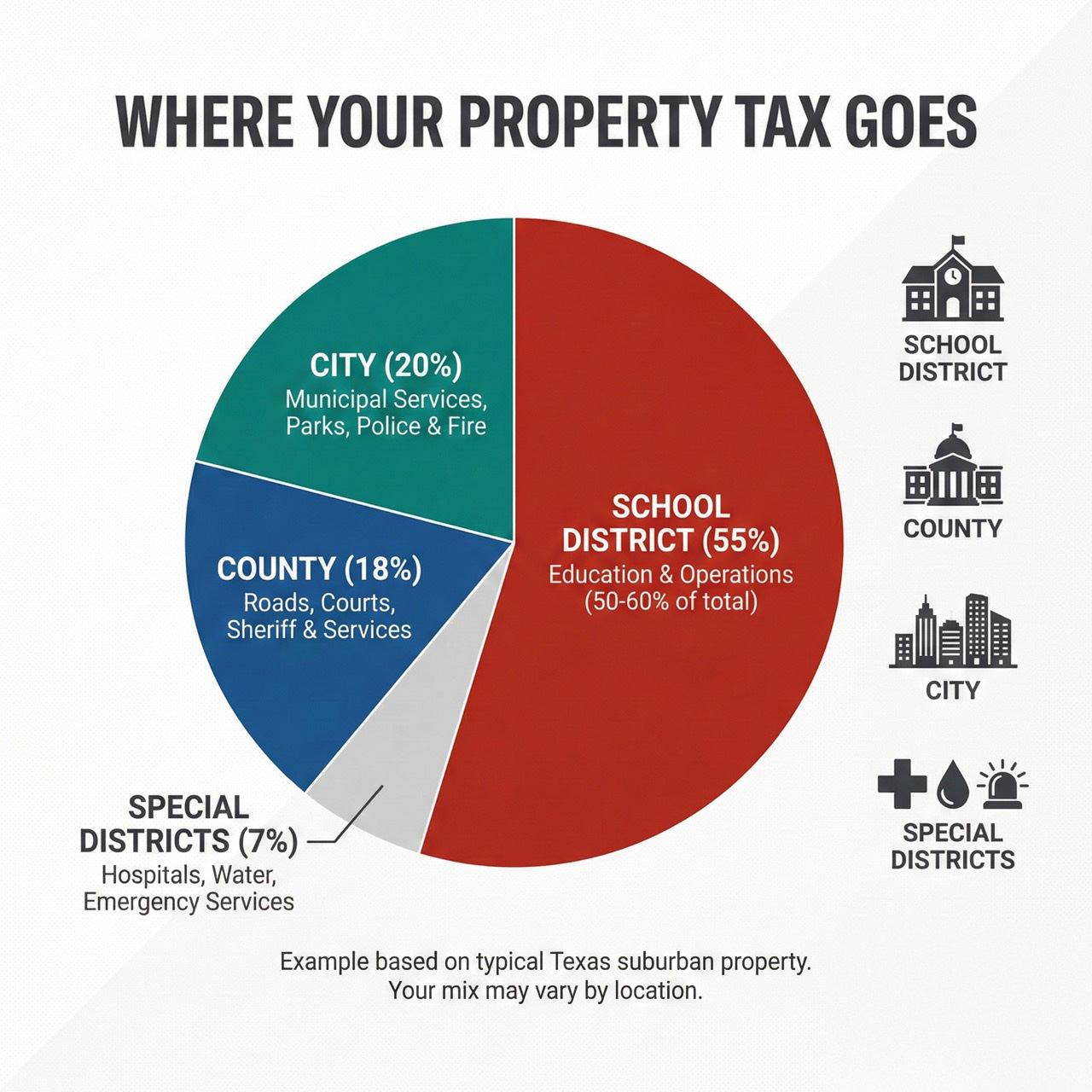
Your property tax bill isn't one tax—it's multiple taxes from different local governments, all collected together. Each taxing unit applies the formula independently.
Typical taxing entities include:
- School district — Often 50-60% of your total bill
- County — Funds county services, roads, and courts
- City (if within city limits) — Funds municipal services
- Special districts — Hospital districts, water districts, community colleges, emergency services, and more
Each entity determines its own budget, calculates the tax rate needed to fund that budget, and applies that rate to your taxable value. Different exemptions apply to different entities, so you may have different taxable values for each—the $140,000 school district exemption, for example, is typically higher than what your city or county offers.
Your total tax bill is simply the sum of all these individual calculations. Learn more about what each entity does in Roles of the CAD, ARB, and Taxing Units.
A Real Example Calculation
Here's how this plays out for a real property.
Property Details
- Home appraised at: $950,000
- Homestead exemption: Yes
- Owner age: Under 65
1Determine Taxable Value
For school district taxes:
- Appraised value: $950,000
- Minus homestead exemption: -$140,000
- Taxable value for school: $810,000
For other entities (assuming $40,000 local homestead exemption):
- Appraised value: $950,000
- Minus local exemption: -$40,000
- Taxable value for city/county: $910,000
2Apply Tax Rates
| Taxing Entity | Rate (per $100) | Taxable Value | Tax Due |
|---|---|---|---|
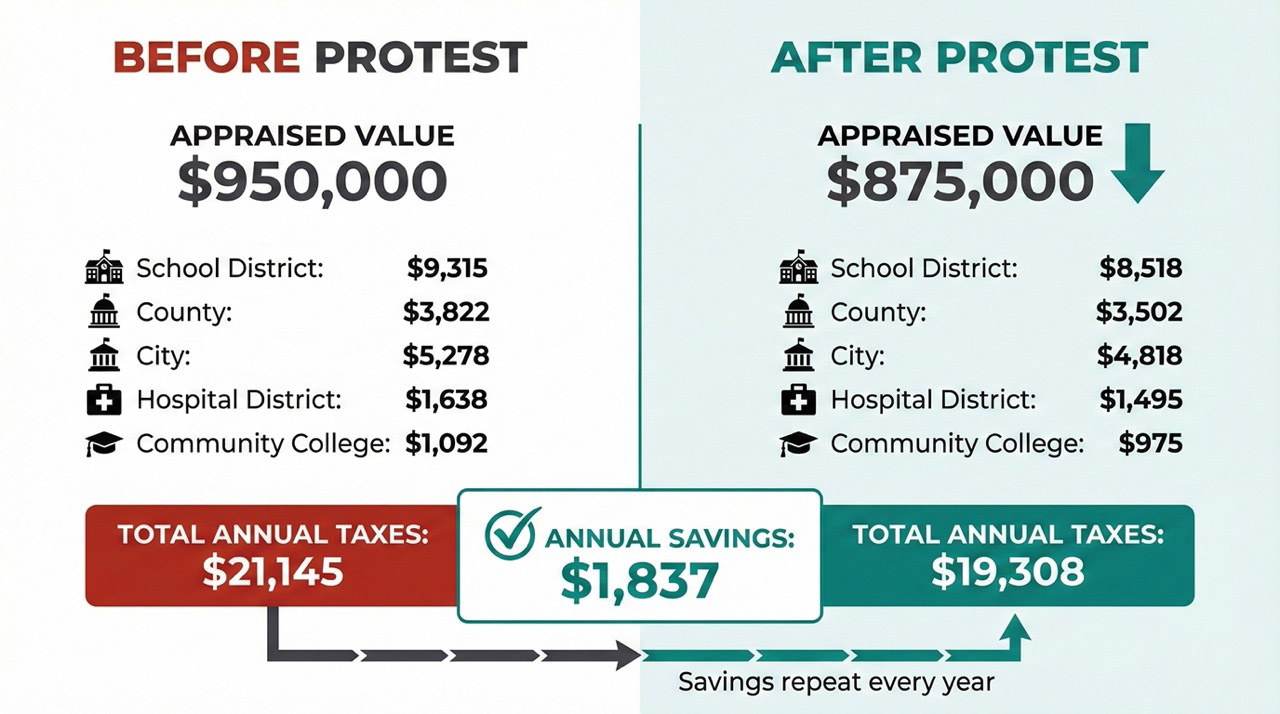
| School District | $1.15 | $810,000 | $9,315 |
| County | $0.42 | $910,000 | $3,822 |
| City | $0.58 | $910,000 | $5,278 |
| Hospital District | $0.18 | $910,000 | $1,638 |
| Community College | $0.12 | $910,000 | $1,092 |
| Total | $2.45 | — | $21,145 |
What If the Appraised Value Were Lower?
If this home's appraised value were reduced by $75,000 (to $875,000):
- New taxable values: $735,000 (school) / $835,000 (others)
- New total tax: approximately $19,308
- Annual savings: approximately $1,837
To estimate your own potential savings, see Estimating Your Potential Savings.
Understanding Tax Rates
Tax rates in Texas are expressed as dollars per $100 of taxable value. A rate of $2.50 per $100 means you pay $2.50 for every $100 your property is worth (after exemptions).
To calculate your tax, multiply your taxable value by the rate and divide by 100.
Example: $400,000 taxable value × $2.50 ÷ 100 = $10,000
Tax rates change each year as taxing units adopt new budgets. When property values rise across a jurisdiction, taxing units may lower rates to collect the same revenue—or keep rates steady to collect more.
This is important: You cannot protest tax rates. Rates are set by elected officials at each taxing unit through a public budget process. What you CAN protest is your property's appraised value. If your value is reduced, you pay less in taxes even if rates stay the same.
For more on what can and cannot be protested, see Tax Rate vs. Property Value: What Can Be Protested.
Key Takeaways
- The formula is simple: (Appraised Value – Exemptions) × Tax Rate = Taxes
- Multiple taxing entities each apply this formula with their own rates—school districts typically take the largest share (50-60%)
- Exemptions reduce your taxable value, lowering your bill. The $140,000 school district homestead exemption is particularly valuable.
- You can protest your appraised value—but not the tax rate. That's where savings opportunities exist.
What's Next?
Now that you understand how property taxes are calculated, you may be wondering how much you could save if your value were reduced. See Estimating Your Potential Savings to run the numbers for your property.
To see how this calculation appears on your actual tax statement, read Understanding Your Property Tax Bill.