Understanding the Texas Property Tax System
Learn how the Texas property tax system works, who collects taxes, how they fund local services, and what homeowners need to know about their obligations.

If you own a home in Texas, property taxes are likely one of your largest annual expenses—often rivaling or exceeding your mortgage payment.
Texas is one of only seven states with no personal income tax. The trade-off? Property taxes fund nearly everything local. Here's how the system works, who gets your money, and what you can do about it.
Texas Has No State Property Tax—So Who Collects Yours?
Most people assume the state collects property taxes. It doesn't. Texas has no state property tax at all. The Texas Comptroller's office does not collect property tax or set tax rates—that responsibility falls entirely to local taxing units.
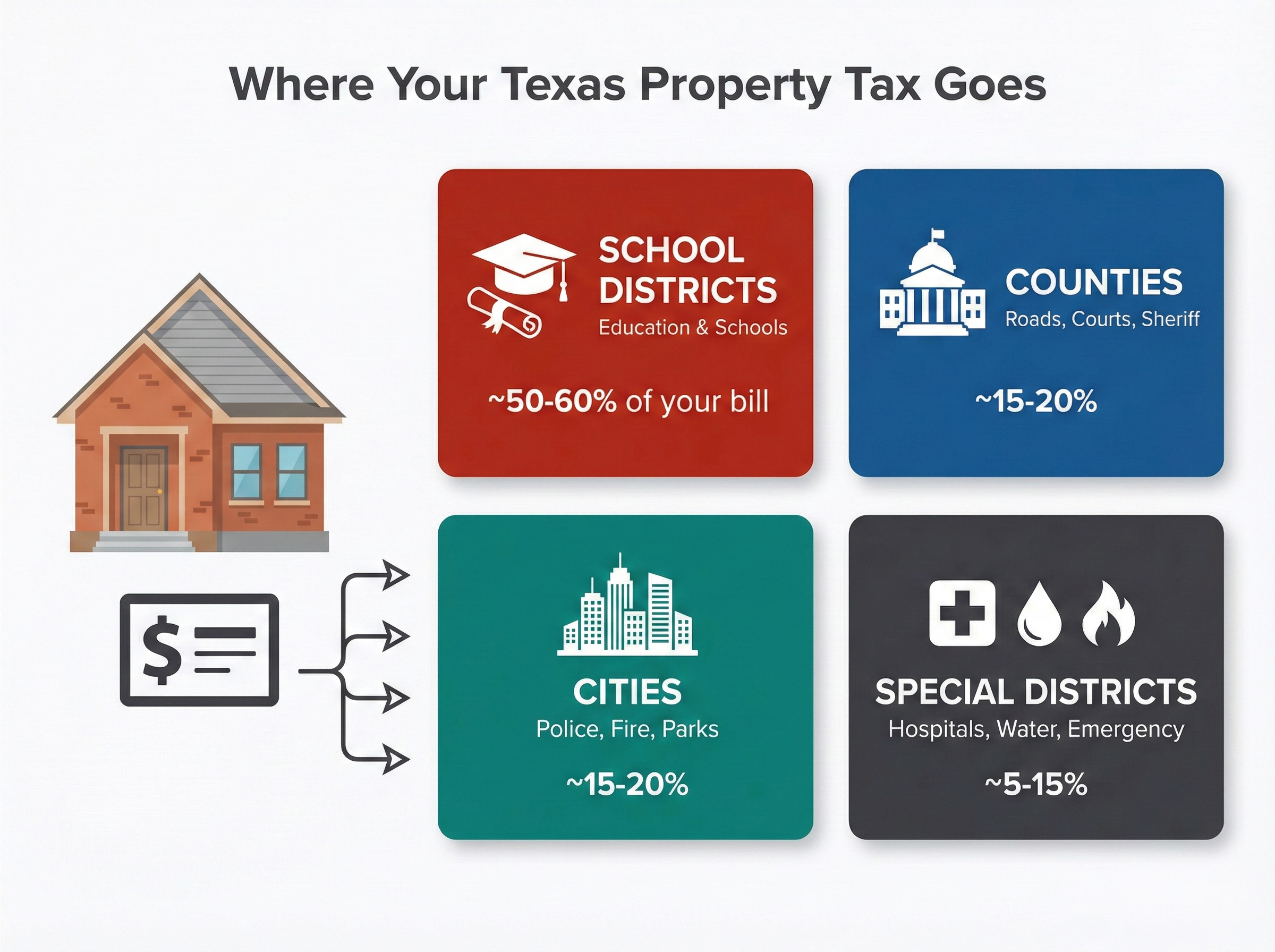
More than 4,796 local taxing units administer property taxes across Texas. These include:
- School districts — Typically the largest portion of your tax bill (often 50% or more).
- Counties — Fund county roads, sheriff's office, county courts, and county services.
- Cities and municipalities — Fund city police, fire, parks, libraries, and city services.
- Special districts — Hospital districts, water districts, community college districts, emergency services districts, and more.
When you pay property taxes, you're actually paying multiple separate taxes to different entities, all collected together. Each entity sets its own tax rate based on its budget needs. This is why your total tax rate is the sum of several different rates.
To understand each of these entities in detail, see our guide to the roles of CADs, ARBs, and taxing units.
How the Property Tax Cycle Works
The Texas property tax cycle follows a predictable annual rhythm. Understanding this timeline helps you know what to expect and when to take action.
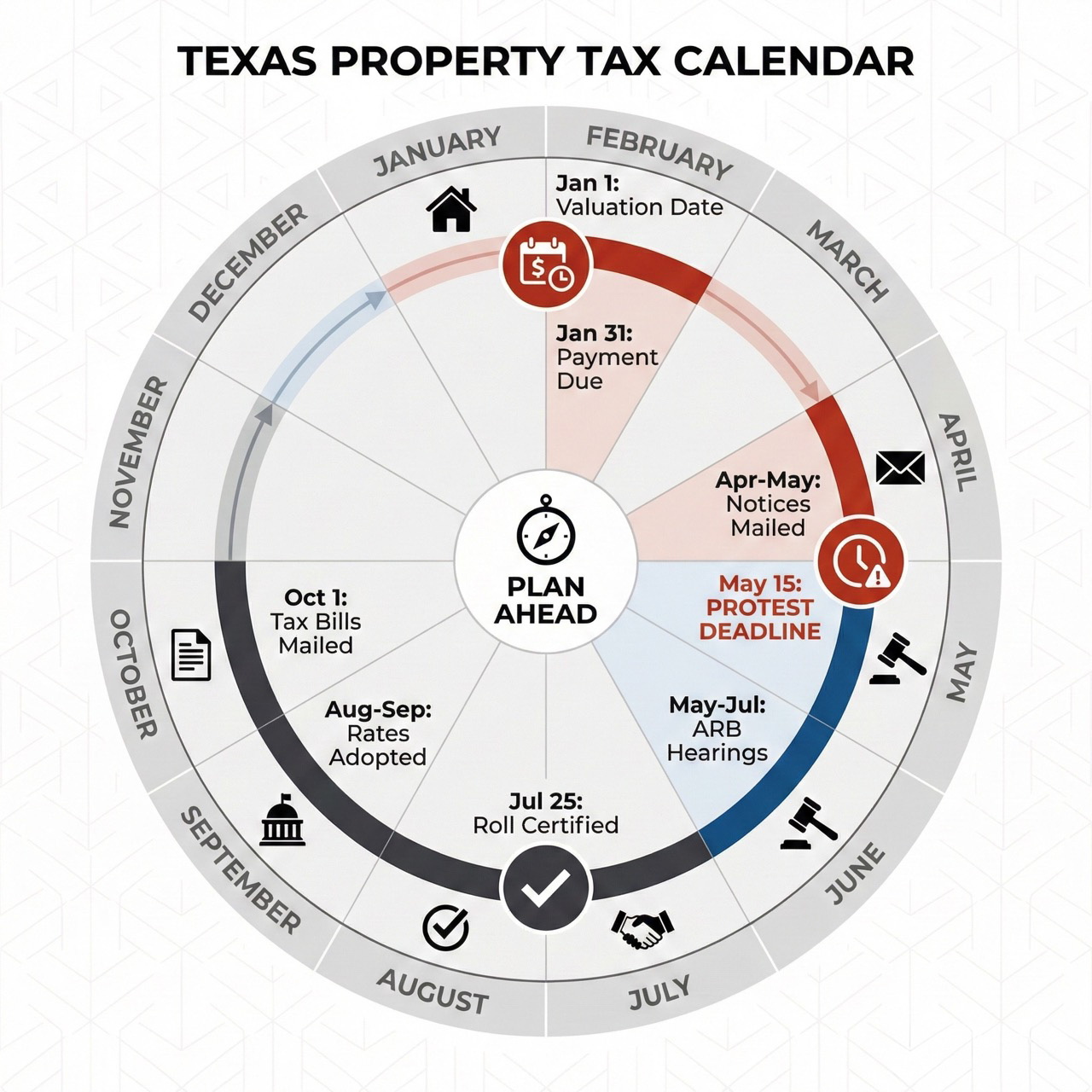
All property in Texas is valued as of January 1 each year. This is the "snapshot" date that determines your property's value for tax purposes. Any changes to your property after this date—additions, damage, renovations—won't affect your taxes until the following year.
In the spring, your County Appraisal District (CAD) sends a Notice of Appraised Value showing what they believe your property is worth. This is NOT your tax bill—it's the value that will be used to calculate your taxes later. If you disagree with this value, this notice triggers your window to protest.
The standard deadline to file a property tax protest is May 15, or 30 days after your appraisal notice is mailed, whichever is later. Mark this date—missing this deadline generally means accepting your appraised value for the year.
The Appraisal Review Board (ARB) hears protests during May through July. Property owners or their representatives can present evidence to challenge their appraised value.
Local taxing units adopt their tax rates for the year based on their budget needs and the total taxable value in their jurisdiction.
Tax assessor-collector offices mail property tax bills, which are due upon receipt.
Property taxes must be paid by January 31 to avoid penalties and interest. Beginning February 1, delinquent taxes accrue penalties starting at 6% plus 1% interest.
For a complete month-by-month calendar, see Property Tax Calendar: Key Dates.
Why Texas Property Taxes Are Higher Than Average
Texas has some of the highest property taxes in the nation. The average effective property tax rate in Texas is approximately 1.63%, compared to the national average of just 0.90%. This makes Texas the 7th highest state for property taxes.
To put that in perspective: on a $500,000 home, you'd pay roughly $8,150 per year at 1.63%. On a $1,000,000 home, that jumps to about $16,300 annually.
Why so high? The answer lies in Texas's tax structure. With no state income tax, Texas relies more heavily on property taxes to fund essential services—particularly public education. School districts typically account for the largest share of a homeowner's property tax bill, often 50% or more.
This isn't necessarily bad news. Texas homeowners keep 100% of their wages (no state income tax withholding), and many find the trade-off worthwhile. However, it does mean that ensuring your property is fairly valued—and not over-assessed—has a significant financial impact.
What matters for homeowners: Texas law gives you strong rights to challenge your property value through the protest process. And unlike some states, Texas law prevents your value from increasing as a result of filing a protest.
For more on why Texas property taxes are among the nation's highest, see Why Texas Property Taxes Are So High.
Your Rights as a Texas Property Owner
Texas law provides homeowners with significant rights regarding property taxes. These aren't suggestions—they're your legal rights.

Right to Notice
You have the right to receive a Notice of Appraised Value each year showing what the appraisal district believes your property is worth. This notice must be sent before the protest deadline.
Right to Protest
Perhaps most importantly, you have the right to formally challenge (protest) your property's appraised value if you believe it's too high. This is a constitutional right in Texas, and the system is designed to give property owners a voice.
Texas law protects property owners from retaliation: your property value cannot be increased as a result of filing a protest. The worst outcome is that your value stays the same.
Right to Exemptions
If you qualify, you have the right to apply for exemptions that reduce your taxable value. The most common is the homestead exemption for your primary residence, but there are also exemptions for seniors, disabled individuals, veterans, and others.
Right to Information
You have the right to information about how your taxes are calculated, including the tax rates set by each taxing unit and how your property's value was determined.
To learn more about the protest process, see What Is a Property Tax Protest?
Key Takeaways
- Texas has no state property tax — All property taxes go to local entities like school districts, counties, cities, and special districts.
- Multiple taxing units share your bill — Your total tax rate is the sum of rates from several different entities, with school districts typically taking the largest share.
- Property values are set as of January 1 each year — This is the snapshot date for your property's value.
- You have the right to protest — And your value cannot increase as a result. The worst case? Your value stays the same.
- The annual cycle runs from January to January — From valuation date to payment deadline, with the critical May 15 protest deadline in between.
What's Next?
Understanding how the system works is the first step. The next step is understanding how your specific tax bill is calculated—and whether your property might be over-valued.
Many homeowners work with a professional service firm like DomuTax that handles everything on their behalf—from filing to hearings—so they can focus on what matters most.
Ready to learn more? See How Property Taxes Are Calculated to understand exactly how your tax bill is determined.