What DomuTax Does for You: Our Full-Service Property Tax Protest
DomuTax handles everything: filing, evidence, hearings, and negotiations. Learn exactly what our property tax protest service includes.

When We Say "We Handle Everything," We Mean It
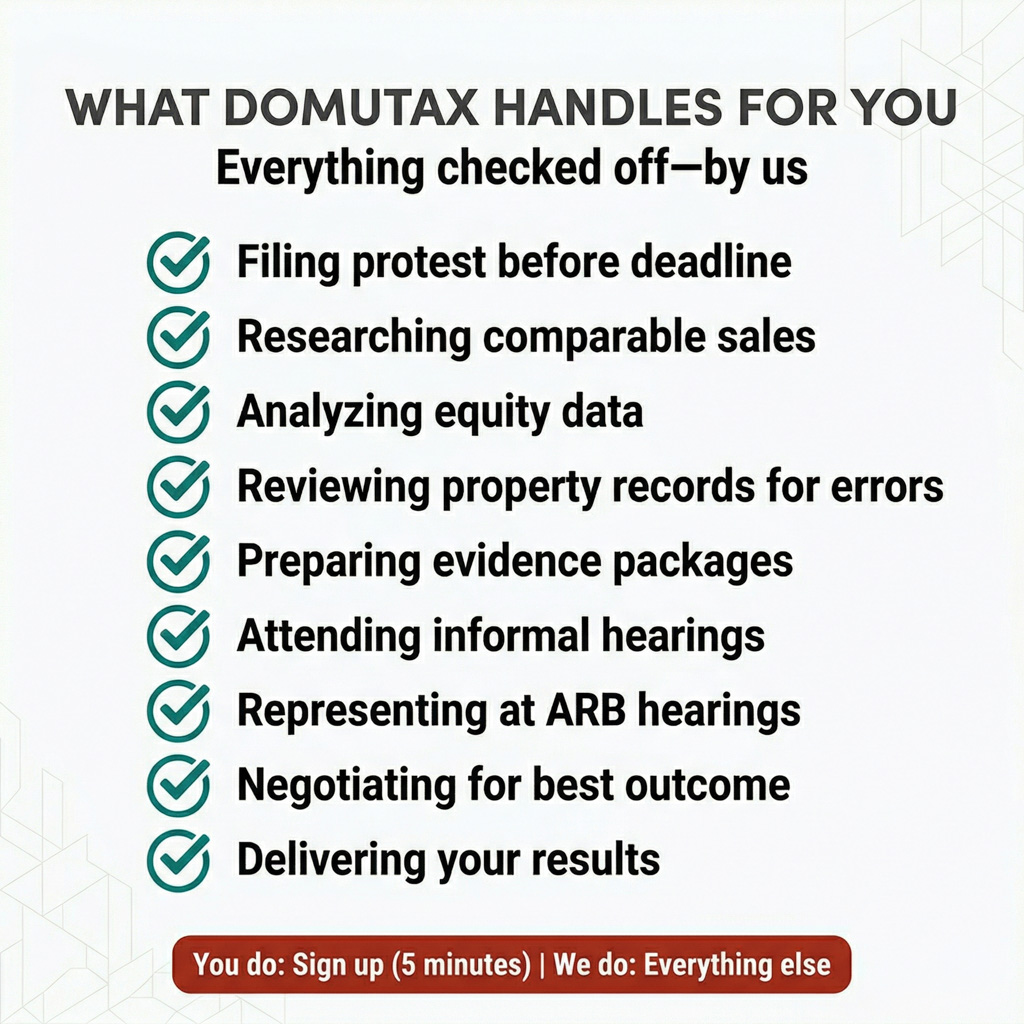
A property tax protest involves multiple steps: filing paperwork before deadlines, researching comparable sales, analyzing equity data, checking property records for errors, preparing evidence, attending hearings, and negotiating with appraisal district staff.
Many homeowners don't protest because the process seems overwhelming. Others try DIY approaches but lack the time, expertise, or comfort with the system to achieve optimal results.
DomuTax exists to remove these barriers entirely. We provide comprehensive, professional representation that covers every aspect of the protest process. Our clients don't need to research, file, prepare, or appear at hearings. We do it all.
Filing Your Protest
The protest process starts with filing a Notice of Protest with your county appraisal district. This must happen before the deadline (May 15 or 30 days after your Notice of Appraised Value, whichever is later). Miss the deadline, and you lose your right to challenge your assessment for that year.
What DomuTax does:
- 1Monitors deadlines — We track when your appraisal district sends notices and when your protest window closes.
- 2Files properly — We submit the official Notice of Protest (Form 50-132) with correct information, proper protest grounds selected, and all required elements completed.
- 3Includes authorization — We file the Appointment of Agent form (Form 50-162) that you signed during enrollment, officially designating DomuTax as your representative.
- 4Confirms receipt and selects grounds — We verify the appraisal district has received and acknowledged your protest, and we identify the strongest legal basis for your case (excessive value, unequal appraisal, errors, etc.).
Filing errors can result in protests being rejected or weakened. Our experience ensures your protest is filed correctly the first time.
Researching Your Property and Building Evidence
The strength of a protest case depends on the quality of evidence. DomuTax invests significant effort in research and analysis for every property we represent.
Comparable Sales Analysis
We research recent sales of properties similar to yours — same neighborhood, similar size, age, and features. If comparable homes sold for less than your assessed value, this provides evidence your property is over-valued.
We analyze:
- Sales within the past 12-24 months
- Properties within a reasonable distance
- Homes with similar square footage, lot size, bedrooms/bathrooms
- Adjustments for differences in features, condition, or location
Equity Analysis (Equal and Uniform)
Texas law requires properties to be appraised equally. If your neighbors' homes are assessed at $150 per square foot while yours is at $180, that's grounds for reduction — even if $180 reflects true market value. This is particularly useful when market values are accurate but your assessment is still higher than your neighbors'. We dig into the appraisal district's records to find these disparities.
Property Record Review
Appraisal districts maintain detailed records on every property. Errors in these records (wrong square footage, incorrect room counts, missed condition issues) can inflate your assessed value.
We've caught errors like 500 extra square feet that inflated a homeowner's value by $50,000. We check square footage accuracy, room and bathroom counts, lot size, construction quality grades, age and condition ratings, and any features that may be incorrectly recorded.

DomuTax uses technology to enhance our analysis. We access extensive sales databases, appraisal district records, and market data to build the strongest possible case. This allows us to identify opportunities and evidence that might be missed in a manual review.
If you have documents that can help — like a recent survey, closing statement, or photos of condition issues — we can incorporate those too. But it's not required.
Representing You at Hearings
You Never Need to Appear — That's the Point
Let's start with the most important part: you don't need to be at any of these hearings. Not the informal meeting, not the ARB panel. While we're presenting your case, you're at work, with your family, or doing literally anything else. That's the whole point of full-service representation.
After a protest is filed, the appraisal district schedules a hearing. Most protests are resolved at informal hearings; those that don't settle proceed to Appraisal Review Board (ARB) hearings.
Informal Hearings
An informal hearing is a one-on-one meeting between your representative and an appraisal district staff appraiser. This is where most cases are resolved. The appraiser reviews your evidence, presents theirs, and negotiations occur.
What DomuTax does:
- Attends the hearing on your behalf (you don't need to be there)
- Presents your evidence package
- Responds to the appraiser's questions and counterarguments
- Negotiates for the best possible value reduction
- Accepts, rejects, or counters settlement offers
Formal ARB Hearings
If informal negotiations don't result in an acceptable outcome, the case goes to the Appraisal Review Board — a panel of citizens who hear evidence and make a binding decision. We attend the ARB hearing as your representative, present evidence to the panel, respond to questions from ARB members, address the appraisal district's presentation, and advocate for the lowest defensible value.
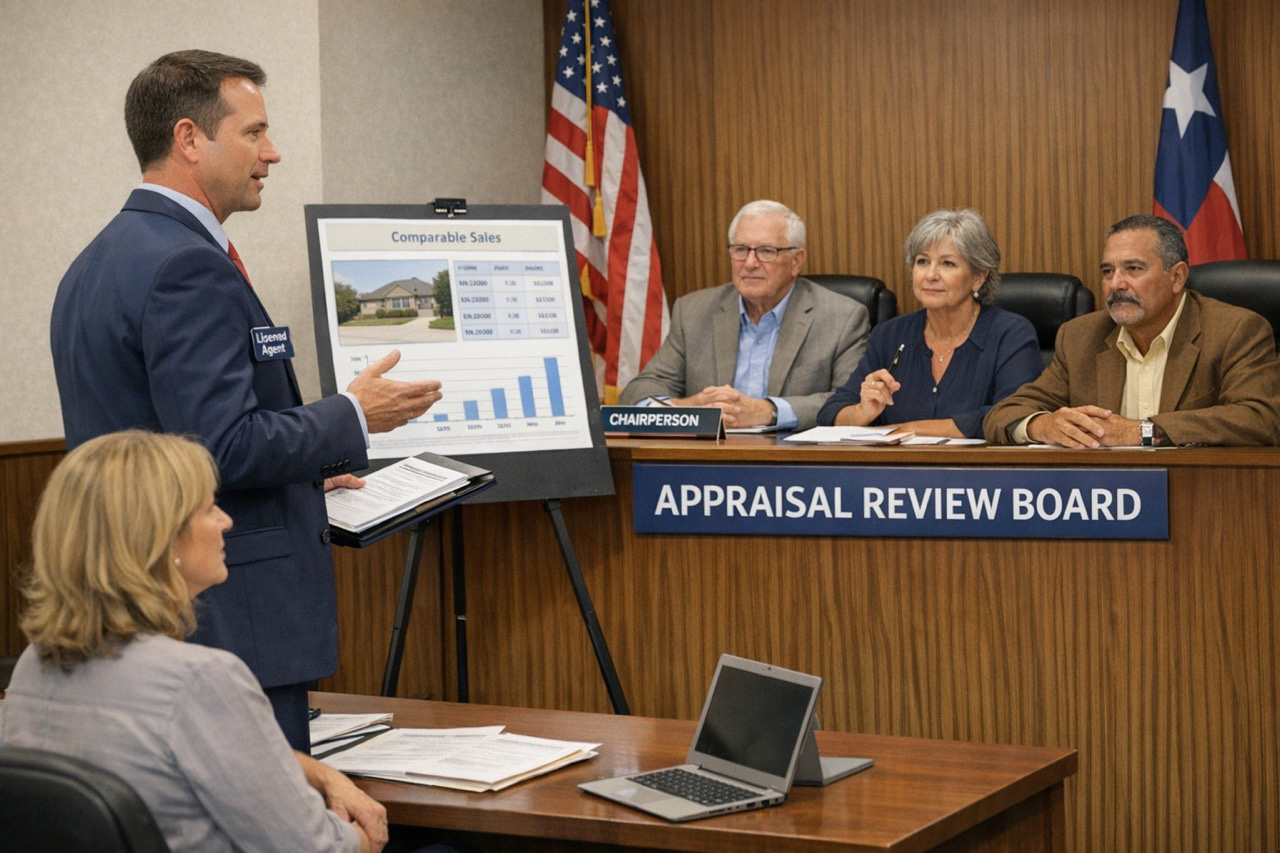
Our licensed property tax agents handle everything — that's what they do every day.
Negotiating for Maximum Results
Anyone can present evidence. Getting the best outcome means knowing how to use it.
DomuTax's negotiation advantage:
Experience with local appraisal districts — We work with the same districts repeatedly and understand their processes, standards, and what types of evidence they find convincing.
Knowledge of valuation methods — We understand how appraisal districts value properties and can identify weaknesses in their approaches.
Realistic but aggressive positioning — We push for the maximum justified reduction while knowing where the lines are. This results in better outcomes than either accepting the first offer or making unrealistic demands that break down negotiations.
Strategic decisions — Sometimes the best outcome comes at informal hearing; sometimes it's worth going to ARB. If the informal offer doesn't reflect your property's true value, we'll take it to the next level. We assess each situation and recommend the path most likely to yield the best result.
Because our fee is based on savings, we're motivated to achieve the largest possible reduction. We don't accept inadequate settlements just to close cases quickly. DomuTax consistently achieves success rates of ~85%, compared to around 60% for protests overall. Our expertise is the reason.
Delivering Your Results
After your hearing concludes and a final value is determined, DomuTax delivers the results to you.
What you receive:
We inform you of the final assessed value and whether a reduction was achieved. If successful, we calculate your tax savings so you understand exactly what was achieved, and you receive records of the protest outcome, including any settlement agreements or ARB orders. If we achieved savings, we send an invoice for our contingency fee (see billing details). You'll also get information about what happens next — certified values, tax bills — and how to continue with DomuTax for future years.
You'll see exactly what we did and why.
Ready for DomuTax Full-Service Representation?
When we say DomuTax handles everything, we mean every step: filing, research, hearings, and negotiation. You just sign up — we take it from there.
DomuTax handles filing, research, hearings, negotiation, and results delivery. Licensed professionals represent you — you never need to appear. Technology and experience produce an 85%+ success rate. Full-service means full-service: you sign up, and we do everything else.
Sign up with DomuTax and we'll handle everything.